2026.07.16
Gamma Knife Treatment for Brain Arteriovenous Malformation (AVM) in Japan: Information for International Patients
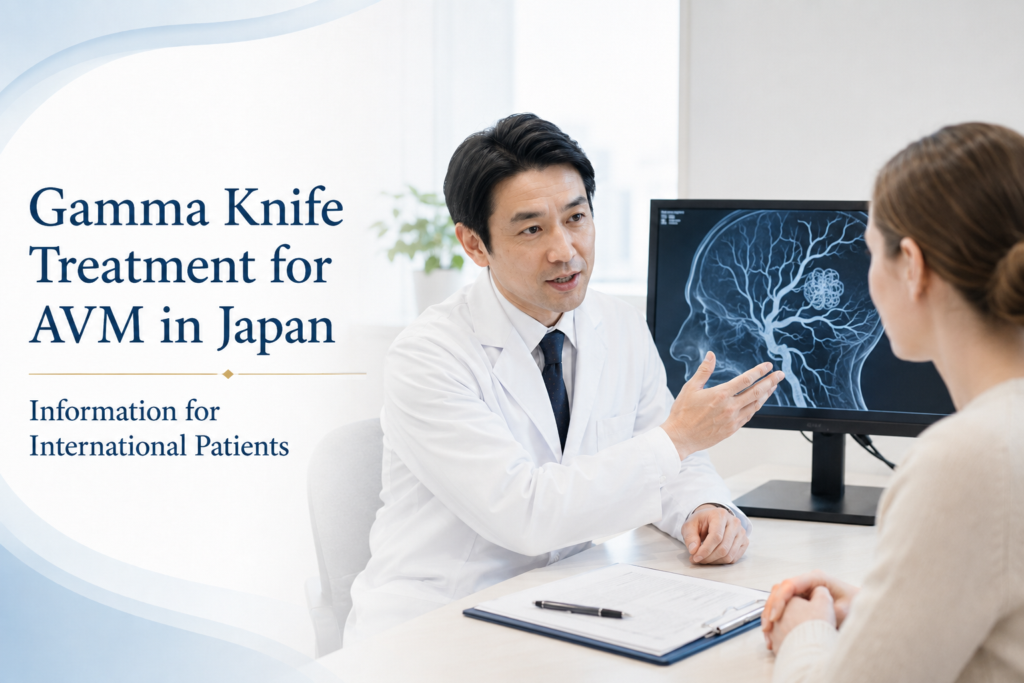
A brain arteriovenous malformation, or AVM, is an abnormal group of blood vessels in which arteries and veins are connected directly without the normal network of capillaries between them. An AVM may be discovered before it causes any symptoms, but it can potentially lead to intracranial hemorrhage.
Gamma Knife treatment is one treatment option for AVM that does not require opening the skull. However, Gamma Knife treatment is not suitable for every AVM. Additional caution is also necessary when a patient is considering traveling from another country to receive treatment in Japan.
As a general rule, international patient consultations are primarily considered for AVMs that are asymptomatic, small, unruptured, and have not caused bleeding. If the AVM has already bled, is causing symptoms such as seizures, is large, or requires urgent treatment, the priority should be to receive prompt medical evaluation and treatment in the country or region where the patient currently lives rather than traveling to Japan.
This article explains the basic structure of an AVM, how Gamma Knife treatment works, the main conditions under which an international patient may be considered for treatment in Japan, and the process from the initial consultation through post-treatment follow-up.
Whether Gamma Knife treatment is appropriate will be determined individually after a specialist reviews the patient’s medical information.
What Is a Brain Arteriovenous Malformation?
A brain arteriovenous malformation is called an “arteriovenous malformation” in English and is commonly abbreviated as “AVM.”
Normally, blood from the arteries flows through a network of small capillaries before entering the veins. In an AVM, the arteries and veins are connected directly without passing through capillaries, creating an abnormal group of blood vessels in the brain.
An AVM Has a Different Blood Flow Structure from Normal Brain Vessels
Arteries carry blood from the heart to the brain. Veins carry blood from the brain back toward the heart. The capillaries located between them help regulate blood flow.
In an AVM, the arteries and veins are connected without this normal capillary network. As a result, blood flows through the vessels in a way that differs from normal cerebral circulation.
An AVM May Be Discovered Before Symptoms Develop
Some people with an AVM have not experienced bleeding, seizures, or other symptoms. This is described as an asymptomatic AVM.
An asymptomatic AVM may be discovered during brain imaging performed for another reason. However, the absence of symptoms alone is not enough to determine whether treatment is necessary or which treatment method may be appropriate.
An AVM Can Potentially Cause Intracranial Hemorrhage
An AVM may cause bleeding inside the skull.
However, the condition of an AVM varies from one patient to another. A specialist will assess factors such as the presence or absence of symptoms, the size of the AVM, and whether rupture or bleeding has occurred before determining whether treatment is necessary and which treatment method may be appropriate.
What Is Gamma Knife Treatment for AVM?
Gamma Knife treatment is a form of radiation treatment that does not require opening the skull. Radiation is delivered from multiple directions and concentrated on the area containing the AVM.
Although the word “knife” is used in the name, no blade is used during treatment. Unlike conventional open brain surgery, Gamma Knife treatment is performed without opening the skull.
However, Gamma Knife treatment is not suitable for every AVM. A specialist will determine whether it may be appropriate after reviewing the condition of the AVM and the patient’s overall situation.
Radiation Is Focused on the AVM Without Opening the Skull
During Gamma Knife treatment, the location and shape of the AVM are identified, and radiation is concentrated on the area to be treated.
Because it does not involve opening the skull, Gamma Knife treatment may be considered a less invasive treatment option for AVM. However, being less invasive does not mean that the treatment is risk-free or appropriate for every patient.
Whether treatment is suitable will be determined individually based on factors including the size of the AVM, the patient’s symptoms, and whether bleeding has occurred.
The AVM Does Not Close Immediately After Treatment
An AVM does not disappear or become completely closed immediately after Gamma Knife treatment.
After treatment, many AVMs gradually close over time. In many cases, this process takes approximately three to five years, although it may take longer.
Not every AVM becomes completely closed. Post-treatment progress differs among patients, and the outcome cannot be guaranteed in advance.
Regular Follow-Up Is Required After Treatment
Because it takes time for an AVM to close, continued follow-up is necessary after Gamma Knife treatment.
The treating physician will monitor changes in the AVM through follow-up imaging and other examinations. If sufficient closure is not confirmed, additional management options may need to be considered.
International patients should confirm before treatment where they will receive follow-up care after returning to their home country or region.
Who May Be Considered for Treatment in Japan?
When an international patient is considering Gamma Knife treatment in Japan, it is necessary to assess not only whether the AVM itself is suitable for treatment, but also whether the patient can safely travel a long distance and receive continued follow-up after treatment.
As a general rule, international patient consultations are primarily considered for AVMs that are asymptomatic, small, unruptured, and have not caused bleeding.
Even when these conditions are met, treatment in Japan is not automatically approved. A specialist must review the patient’s medical images and clinical information and make an individual assessment.
Main Conditions for an International Treatment Consultation
International patients may be considered for a consultation about Gamma Knife treatment in Japan when the following conditions generally apply:
- There are no symptoms such as bleeding or seizures
- The AVM is small
- The AVM has not ruptured or caused bleeding
- The patient does not require urgent medical evaluation or treatment
- The patient can receive the necessary follow-up care after returning home
Whether an AVM qualifies as “small” cannot be determined by the patient simply by reviewing a measurement in a medical report.
A specialist must review the medical images and clinical information to determine whether the patient may be considered for treatment in Japan.
The absence of current symptoms also does not guarantee that treatment is necessary, safe, or appropriate. The decision must take into account the patient’s symptoms, the size of the AVM, whether bleeding has occurred, and whether an appropriate follow-up system is available after treatment.
Patients with Bleeding or Symptoms Should Prioritize Local Medical Care
If the AVM has already caused bleeding or the patient is experiencing symptoms such as seizures, traveling from another country to receive treatment in Japan is generally not appropriate.
After bleeding has occurred or symptoms have developed, the patient’s condition may change and prompt evaluation or continued medical care may be required.
Rather than preparing to travel to Japan, the patient should prioritize receiving immediate medical evaluation and any necessary treatment from a medical institution in the country or region where they are currently located.
The same applies if the AVM is large or the condition is considered urgent. Receiving care at a nearby medical institution is generally safer than arranging treatment that requires long-distance travel and advance coordination.
This does not mean that symptomatic AVMs cannot be treated. Symptomatic AVMs are treated in Japan. However, for international patients, it is also necessary to consider whether changes in the patient’s condition can be addressed promptly and whether continued medical care is available nearby.
Follow-Up Care After Returning Home Is Important
After Gamma Knife treatment, many AVMs gradually move toward closure over time. Continued follow-up is therefore necessary.
International patients will normally return to their country or region of residence after receiving treatment in Japan.
Before treatment, patients should confirm whether they have access to a medical institution that can provide follow-up examinations and imaging, as well as a physician they can consult if their condition changes.
Even when the AVM appears to meet the general conditions for an international consultation, treatment in Japan may not be considered appropriate if the patient cannot receive the necessary follow-up care after returning home.
Final Eligibility Is Determined Individually by a Specialist
Being asymptomatic, having a small AVM, and having no previous rupture are general criteria for considering treatment in Japan.
These conditions alone do not mean that Gamma Knife treatment will be provided.
A specialist will review the patient’s medical images and clinical information and assess the following:
- Whether Gamma Knife treatment is appropriate for the AVM
- Whether treatment involving travel to Japan can be performed safely
- Whether urgent medical evaluation or treatment is required
- Whether the patient can continue the necessary follow-up after returning home
Patients who wish to receive treatment in Japan should submit their medical information and confirm whether they may be considered for treatment before booking flights or accommodation.
From the Initial Consultation to Follow-Up After Returning Home
International patients considering Gamma Knife treatment for an AVM in Japan must first submit medical information for review by a specialist.
Travel and treatment preparations begin only after the specialist determines that the patient may be a potential candidate.
An initial consultation does not confirm that treatment will be provided. Depending on the patient’s condition, additional information may be required, or medical care in the patient’s current country or region may be considered more appropriate than traveling to Japan.
1. Submit Medical Information Before Traveling
The first step is to submit information that allows the specialist to assess the AVM, including previous medical records and medical images.
The specific documents required and the method of submission will be explained individually. Additional documents may be requested if the information initially provided is insufficient.
At this stage, it is important not to book flights or accommodation before receiving the results of the specialist’s review.
2. A Specialist Reviews Whether Treatment May Be Appropriate
Based on the submitted medical information, the specialist will primarily assess:
- Whether the AVM has caused bleeding, seizures, or other symptoms
- Whether the AVM has ruptured
- Whether the size of the AVM meets the general criteria for international patients
- Whether urgent medical evaluation or treatment is required
- Whether the patient can receive the necessary follow-up care after returning home
After reviewing these factors together, the specialist will determine whether the patient may be a potential candidate for Gamma Knife treatment and whether treatment involving travel to Japan may be appropriate.
3. Begin Travel Preparations After Being Identified as a Potential Candidate
If the specialist determines that the patient may be a potential treatment candidate, the patient can begin preparing for travel and treatment based on the instructions provided.
Treatment abroad requires planning not only for the treatment date but also for the stay in Japan and follow-up care after returning home.
The matters that must be confirmed before treatment will vary depending on the patient’s condition and treatment plan.
4. Receive Gamma Knife Treatment in Japan
During Gamma Knife treatment, the location and shape of the AVM are identified, and radiation is concentrated on the treatment area.
The specific treatment plan and the schedule before and after treatment will be explained individually after the patient’s condition has been assessed.
Treatment effects and post-treatment progress vary among patients, and the outcome cannot be guaranteed in advance.
Patients should ask the specialist about anything they do not understand and receive treatment only after they understand the explanation provided.
5. Continue Follow-Up After Returning Home
An AVM does not become completely closed immediately after Gamma Knife treatment.
Many AVMs gradually close over approximately three to five years after treatment. However, the process may take longer, and some AVMs may not become completely closed.
Patients must therefore continue medical examinations and imaging follow-up after returning home, according to their physician’s instructions.
Before receiving treatment abroad, patients should confirm which medical institution will provide follow-up care after they return home and whom they should contact if their condition changes.
Why Consider Gamma Knife Treatment in Japan?
For an AVM that is asymptomatic, small, unruptured, and has not caused bleeding, Gamma Knife treatment in Japan may be one possible treatment option.
When considering treatment abroad, patients should review not only the treatment method but also the facility’s treatment experience, the consultation process before travel, language support, and follow-up arrangements after returning home.
Treatment Is Performed Without Opening the Skull
Gamma Knife treatment delivers focused radiation to the AVM without opening the skull.
Because the procedure differs from open brain surgery, it may be considered as a less invasive treatment option.
However, being less invasive does not mean that the treatment is free of risk or appropriate for every AVM.
A specialist will determine eligibility individually after assessing the patient’s symptoms, the size of the AVM, and whether rupture or bleeding has occurred.
More Than 5,000 Gamma Knife Procedures Have Been Performed Since 2004
More than 5,000 Gamma Knife procedures have been performed at Koto Memorial Hospital and the Shiga Gamma Knife Center since 2004.
This figure represents all Gamma Knife procedures performed at the center and is not limited to AVM treatment.
The number of procedures performed does not guarantee the treatment outcome or safety for an individual patient.
Whether Gamma Knife treatment is appropriate for a particular AVM will be determined after a specialist reviews the patient’s medical information.
You Can Discuss the Possibility of Treatment Before Traveling
International patients can submit their medical information before traveling to Japan and request a preliminary assessment of whether they may be considered for treatment.
This review helps determine whether the AVM meets the general criteria for international patients and whether treatment involving travel to Japan may be appropriate.
However, the preliminary consultation does not guarantee that treatment will be provided.
Additional medical information may be required, or the specialist may determine that receiving medical care in the patient’s current country or region is more appropriate.
Treatment Planning Includes Follow-Up After Returning Home
After Gamma Knife treatment, many AVMs gradually close over approximately three to five years.
Because the process may take longer and complete closure may not occur, continued follow-up is necessary.
International patients are expected to return to their country or region of residence after receiving treatment in Japan.
Treatment planning must therefore include not only the procedure in Japan but also where the patient will receive medical examinations and imaging after returning home.
When considering treatment in Japan, patients should review the treatment method, medical assessment before travel, language support, and follow-up arrangements after returning home.
Frequently Asked Questions About Gamma Knife Treatment for AVM
What Should I Prepare for the Initial Consultation?
Please prepare information that will allow the specialist to assess the AVM, including previous medical records and medical images.
The required documents will vary depending on the patient’s situation.
Please follow the instructions provided during the initial consultation regarding the types of images, examination results, medical record formats, and submission method required.
If it is difficult to make an assessment based on the submitted information, additional documents or examination results may be requested.
Can I Request a Consultation in a Language Other Than English?
Information and assistance for international patients are available in English and Spanish.
However, the same level of language assistance may not be available at every stage, including the initial inquiry, medical consultation, and treatment explanation.
Please confirm during the consultation what type of support is available in your preferred language.
Is Treatment Confirmed Through the Online Consultation?
Gamma Knife treatment is not confirmed based only on an online or preliminary consultation.
The specialist will review the submitted medical images and clinical information to assess whether the AVM may be suitable for an international treatment consultation.
Additional documents may be required if the information provided is insufficient.
The preliminary review may also determine that Gamma Knife treatment is not appropriate or that receiving medical care in the patient’s current country or region is preferable to traveling to Japan.
Can I Book My Flight and Accommodation Before the Consultation?
We do not recommend booking flights or accommodation before the specialist has completed the preliminary review.
Depending on the condition of the AVM, treatment involving international travel may not be appropriate.
Even when the patient may be a potential candidate, additional documents may need to be reviewed or the treatment schedule may require further coordination.
Please submit your medical information first and confirm whether you may be considered for treatment. Travel preparations should begin only after receiving instructions from the medical institution.
Where Will I Receive Follow-Up Care After Treatment?
International patients are generally expected to receive follow-up care at a medical institution in their home country or region after treatment in Japan.
After Gamma Knife treatment, many AVMs gradually close over approximately three to five years.
Continued medical examinations and imaging are therefore necessary after the patient returns home.
The medical institution providing follow-up care and the timing of examinations will vary depending on the patient’s condition.
Before receiving treatment in Japan, patients should confirm where they will receive follow-up care and how they can obtain medical advice after returning home.
Do I Need Immediate Treatment Even If I Have No Symptoms?
The absence of symptoms alone is not enough to determine whether treatment is necessary or when it should be performed.
A specialist must review the size of the AVM, whether rupture or bleeding has occurred, and other medical information before determining whether treatment is appropriate.
An asymptomatic, small, and unruptured AVM is one of the general conditions under which an international treatment consultation may be considered.
However, this does not mean that treatment is always necessary or that Gamma Knife treatment is appropriate.
What Happens If the AVM Does Not Become Completely Closed?
Not every AVM becomes completely closed after Gamma Knife treatment.
If follow-up examinations do not confirm sufficient closure, a specialist will consider the appropriate next steps.
The management required will depend on the condition of the AVM and its progress after treatment.
Before treatment, patients should receive an explanation not only about the expected course but also about the possible options if complete closure is not achieved.
For Patients Considering Gamma Knife Treatment in Japan
International patients considering Gamma Knife treatment for an AVM in Japan should undergo a preliminary specialist review before beginning travel preparations.
As a general rule, consultations are primarily considered for AVMs that are asymptomatic, small, unruptured, and have not caused bleeding.
If the AVM has already caused bleeding, is producing symptoms such as seizures, is large, or requires urgent treatment, receiving prompt medical evaluation and treatment in the patient’s current country or region should take priority over traveling to Japan.
During the preliminary consultation, a specialist will review the submitted medical images and clinical information and determine individually whether the patient may be a potential candidate for Gamma Knife treatment and whether treatment involving travel to Japan may be appropriate.
Continued follow-up will also be necessary in the patient’s home country or region after treatment.
Patients should confirm in advance whether they have access to a medical institution that can provide examinations and imaging after they return home.
If you have an asymptomatic, small, and unruptured AVM and are considering Gamma Knife treatment in Japan, please contact us through Request Your Consultation.
The preliminary consultation does not guarantee that treatment will be provided or that a particular outcome will be achieved.
Depending on the patient’s condition, receiving medical care in the country or region where the patient currently lives may be considered more appropriate than traveling to Japan.