2026.09.22
Gamma Knife for Pituitary Adenoma (PitNET): When May Radiosurgery Be Considered?
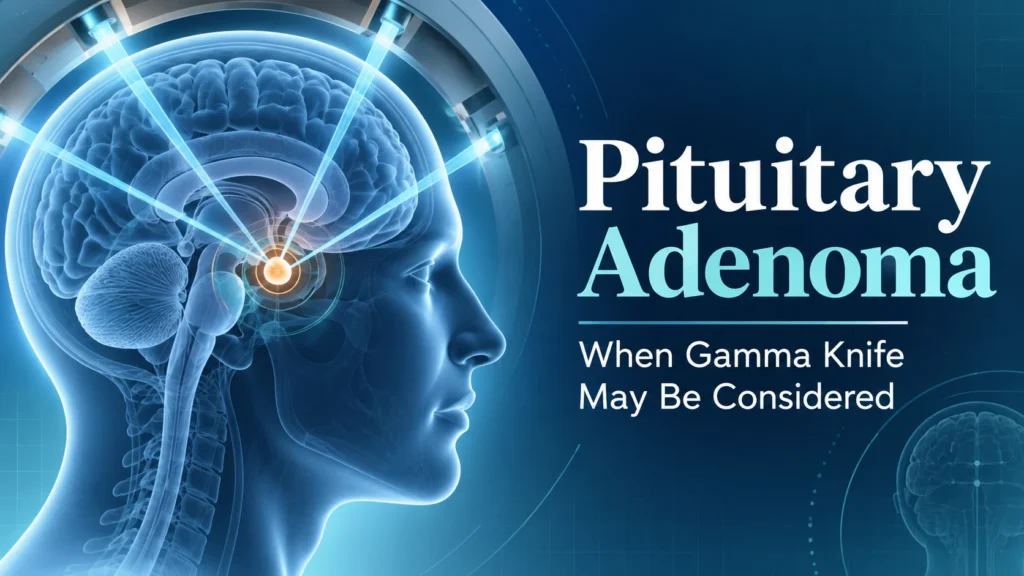
Gamma Knife treatment may be an appropriate option for some patients with pituitary adenoma. It is most often considered when tumor remains after surgery, when a previously treated tumor has started to grow again, or when excess hormone production has not been brought under control by earlier treatment. However, it is not the first treatment used (first-line treatment) for every pituitary adenoma. For many patients, surgery or medication comes first, and radiosurgery is considered afterward or in specific situations.
Whether Gamma Knife can be considered in your case depends on the size and location of the tumor, its distance from the optic nerves and optic chiasm (the point where the optic nerves cross), whether the tumor produces hormones, and what treatment you have already received. These factors cannot be assessed without actually reviewing your imaging and medical records. This article explains how specialists approach this decision. Please use it as background when you talk with your doctor.
What Is a Pituitary Adenoma (PitNET)?
A pituitary adenoma is a tumor that arises from the hormone-producing cells of the anterior pituitary gland, located at the base of the brain. Most follow a slow course, but some may extend into surrounding structures or grow again after treatment. By pressing on nearby structures or producing excess hormones, these tumors can also have a major impact on daily life.
The 2022 WHO Classification of Endocrine and Neuroendocrine Tumors (and the 2021 WHO Classification of Tumors of the Central Nervous System) now recommend the name pituitary neuroendocrine tumor (PitNET). This reflects the fact that these tumors have the characteristics of neuroendocrine tumors and range from small tumors with a mild course to tumors with a strong tendency to extend locally. However, the term “pituitary adenoma” continues to be widely used by patients, by many clinicians, and in the treatment studies published to date, so you are likely to see both names. In this article, we mainly use “pituitary adenoma,” the term many patients know, and add “PitNET” where helpful.
Pituitary adenomas fall into two broad groups.
Functioning tumors (hormone-secreting tumors): These tumors produce excess hormones. Typical examples are prolactin-secreting tumors (prolactinomas), growth hormone (GH)–secreting tumors (which cause acromegaly), and adrenocorticotropic hormone (ACTH)–secreting tumors (which cause Cushing’s disease). Symptoms mainly result from the hormone excess itself.
Nonfunctioning tumors: These tumors do not cause symptoms from hormone excess. They are found because of visual field loss caused by pressure on the optic nerves and optic chiasm, headaches, or symptoms of reduced pituitary function, and some are discovered incidentally on imaging done for another reason.
This distinction not only shapes the treatment plan but also affects how the “effectiveness” of any treatment, including Gamma Knife, is measured.
How Are Pituitary Adenomas Usually Treated?
Treatment varies considerably by tumor type, and there is no single approach that applies to every patient.
Prolactinomas: Medication is generally used first. Dopamine agonists can be expected to lower prolactin levels and shrink the tumor, and they are considered the standard first-line treatment for many patients. Surgery is considered in selected situations.
Growth hormone–secreting and ACTH-secreting tumors: If the patient’s overall health allows them to undergo surgery, surgery is generally performed first. When surgery does not achieve control, medication or radiation-based treatment is used.
Nonfunctioning adenomas: An international consensus statement from the Pituitary Society published in 2025 (covering incidentally discovered pituitary lesions) recommends surgery when there is visual field loss, cranial nerve palsy, or pituitary apoplexy. The same consensus states that the choice between observation and surgery should be made individually, based on the size and location of the lesion and the clinical situation. Before that, a 2011 Endocrine Society guideline described similar indications for surgery, including visual field loss, other visual abnormalities caused by compression, and contact with the optic nerves or optic chiasm. For small tumors without these findings, observation with MRI, hormone testing, and visual field testing may be chosen.
Radiosurgery and radiation therapy (including Gamma Knife): These are often used as second- or third-line treatments after surgery or medication.
Gamma Knife does not replace surgery or medication. It is one part of a treatment strategy involving multiple specialties, and the order of treatments differs from patient to patient.
When May Gamma Knife Be Considered?
Radiosurgery may be considered as an option in the following situations.
Tumor remaining after surgery: When a tumor is large or has invaded surrounding tissue, complete removal can be difficult. International practice guidance recommends that, for patients with residual tumor after surgery, a multidisciplinary team discuss whether to perform radiosurgery early or to monitor the tumor and treat it if it grows.
Recurrent tumor: Regrowth after previous surgery is one of the most common situations in which radiosurgery is considered.
Tumor in an anatomically difficult location: For example, tumors that extend into the cavernous sinus can be difficult to remove completely, making residual tumor more likely.
Excess hormone production that continues after treatment: When hormone oversecretion persists after surgery (with or without medication), radiosurgery may be used, particularly for growth hormone–secreting and ACTH-secreting tumors.
Patients for whom further surgery is not considered appropriate: For example, when surgical risk is high because of overall health or other reasons, or when the patient does not wish to have another operation.
Prolactinomas that respond poorly to dopamine agonists, or when the medication cannot be continued because of side effects: Radiosurgery may be considered as an alternative to repeat surgery.
None of these situations means that Gamma Knife will automatically be performed. Rather, each is a situation in which Gamma Knife should be evaluated alongside other options.
When Might Gamma Knife Not Be the First Option?
In the following cases, another treatment is generally more appropriate.
Large tumors causing symptoms from compression: The effects of radiosurgery appear gradually over months to years. It is not a way to quickly relieve pressure that is occurring now. Surgery can relieve pressure much faster.
Tumors that are extremely close to, or pressing on, the optic nerves or optic chiasm: Around the pituitary gland, the optic nerves and optic chiasm are structures that are especially sensitive to radiation, and the dose they receive must be strictly limited. If the tumor is in contact with these structures, single-session treatment may not be possible to deliver safely. Surgery may first be recommended to create some distance between the tumor and these structures, or a different radiation approach may be considered.
Rapidly worsening vision or visual fields, or pituitary apoplexy: These require urgent neurosurgical evaluation, not radiosurgery.
When another treatment is expected to be more effective: For example, a prolactinoma that is responding well to medication, or a previously untreated patient who is a good candidate for surgery and in whom surgery can be expected to achieve early hormonal remission.
This is why the distance between the tumor and the optic nerves and optic chiasm is one of the first things a radiosurgery team checks on MRI.
Tumor Control and Endocrine Remission Are Different Outcomes
This distinction is essential for understanding published treatment results, yet the two are often confused in information written for patients.
Imaging-based (local) tumor control: This means the tumor is not growing, or is shrinking, on follow-up MRI.
Endocrine (biochemical) remission: This means hormone levels that were abnormal have returned to normal. It is assessed using criteria set by endocrine consensus statements for each condition, and the effect of any hormone-suppressing medication the patient is taking on test results is also taken into account.
These are not the same outcome, and they are achieved at different rates. A tumor can be well controlled on imaging while hormone levels still fall short of target and medication needs to continue. For this reason, a single “success rate” for Gamma Knife for pituitary adenoma is not meaningful. Treatment results should always be read as answers to two separate questions: What happened to the tumor? And what happened to the hormones?
Note that the criteria for endocrine remission have become stricter over the years and also differ from study to study. This is one reason reported remission rates vary so widely.
How Effective Is Gamma Knife?
Most of the published evidence comes from retrospective studies at individual centers, combined in systematic reviews. All of these figures describe results in selected patient groups; they are not the outlook for any individual patient.
Nonfunctioning adenomas: A meta-analysis by the International Stereotactic Radiosurgery Society (ISRS) (35 studies, 2,671 patients) reported local tumor control of 94% at 5 years (95% confidence interval [CI], 93–96%) and 83% at 10 years (95% CI, 77–88%) after single-session stereotactic radiosurgery (SRS). Tumor control is high in appropriately selected patients but declines somewhat over the long term. This is why long-term imaging follow-up is considered important.
In addition, a 2024 systematic review and meta-analysis limited to nonfunctioning adenomas that remained or recurred after surgery (24 studies, 3,781 patients; mean follow-up of 60 months across the included studies) reported tumor control of approximately 92.3%. However, this 92.3% is a pooled proportion from a single-arm meta-analysis, which is a different measure from time-point control rates such as “94% at 5 years” and “83% at 10 years” above. These figures cannot be directly compared or combined.
Functioning adenomas: An ISRS systematic review (45 studies) reported that tumor control was high for every tumor type, while the proportion of patients who achieved endocrine remission was considerably lower.
| Tumor type | Tumor control (pooled) | Endocrine remission (pooled) | New hypopituitarism |
|---|---|---|---|
| Acromegaly (GH-secreting) | 97% (96–98%) | 44% (35–53%) | 17% (13–23%) |
| Cushing’s disease (ACTH-secreting) | 92% (87–95%) | 48% (35–61%) | 21% (13–31%) |
| Prolactinoma | 93% (90–95%) | 28% (19–39%) | 12% (6–24%) |
Pooled crude rates and 95% confidence intervals from the ISRS systematic review and practice recommendations.
Hormonal improvement takes time. Because the effect of radiosurgery on hormone secretion develops gradually, rates reported at the last follow-up may underestimate the proportion of patients who ultimately achieve remission. In one report on Cushing’s disease, the proportion of patients in remission was 34% at 1 year after treatment, 54% at 2 years, 72% at 3 years, and 78% at 5 years, and the median time to remission was about 17 months. In one report on acromegaly, the remission rate rose from 11% at 2 years to 60% at 5 years.
These figures come from published patient groups. They do not predict individual results, and results for one tumor type cannot be applied to another.
Risks and Long-Term Follow-Up
Gamma Knife is generally well tolerated, but it is not without risk, and some effects appear years later.
A new deficiency of pituitary hormones (hypopituitarism) is the most common long-term complication. In the ISRS meta-analysis of nonfunctioning adenomas, the pooled rate of new hypopituitarism after single-session SRS was 21% (95% CI, 15–27%). For functioning tumors, reported rates are 17% for acromegaly, 21% for Cushing’s disease, and 12% for prolactinoma, although the range across individual studies is much wider. The 2024 meta-analysis limited to tumors remaining or recurring after surgery reported hypopituitarism after treatment in 13.62% and panhypopituitarism in 2.55% (because the patient populations and methods of calculation differ, these figures cannot be directly compared with those above).
Because this risk accumulates over time, and because untreated hormone deficiency can have adverse effects on health, long-term endocrine follow-up is part of the treatment, not an optional extra. If a deficiency develops, hormone replacement therapy under the care of an endocrinologist is the usual approach.
Damage to vision or to other cranial nerves is uncommon. Individual studies of nonfunctioning adenomas have reported decline in visual function at rates of 0% to 7%, with other cranial nerve problems in a similar range, and most were temporary. The 2024 meta-analysis mentioned above reported new visual field deficits in 3.94%, and problems with the cranial nerves (oculomotor, trigeminal, and abducens nerves) in less than 1% each. Treatment planning that takes the optic nerves and optic chiasm into account plays a central role in keeping this risk low. A formal assessment of vision and visual fields before treatment is recommended.
Follow-up with imaging and testing: ISRS practice guidance recommends regular follow-up that includes neuro-ophthalmology and endocrine evaluations, along with MRI follow-up for at least 5 years. One example schedule is every 6 months in the first year, once a year through year 5, and every 2 years after that, with earlier imaging if symptoms change. Because regrowth has been reported many years after treatment, follow-up should not be stopped just because early scans were stable.
Your actual follow-up intervals will be set by your care team based on the status of the tumor and your hormones.
What Happens During Gamma Knife Treatment
Gamma Knife treatment focuses many thin beams of radiation on a single point to treat the target. It involves no skin incision and no opening of the skull.
In general terms, the head is held in a stable position, images are taken to map the tumor and surrounding structures, physicians and medical physicists create a treatment plan, and treatment is delivered while you lie still. The number of sessions, the method used to secure the head, whether a hospital stay is needed, and the length of stay vary depending on the tumor and the policies of the facility. Please confirm the specific process with the facility where you will be seen.
You do not feel the radiation itself. Effects on the tumor and hormone levels appear gradually over the following months to years. This is not a treatment with immediate results.
If you are taking medication to suppress hormones, your doctors may discuss whether to pause it temporarily around the time of treatment. Do not stop any medication on your own; always follow your doctor’s instructions.
How to Get a Second Opinion in Japan
Whether Gamma Knife is appropriate cannot be determined from a diagnosis alone. An actual evaluation requires the following materials.
MRI images: The original image data is preferable to printed images. In addition to your most recent scan, having earlier scans available for comparison allows a more reliable assessment.
Pathology results (if you have had surgery): Including the tumor type and immunostaining results.
Surgical history: Operative reports, the extent of removal, and whether any tumor remains.
Endocrine and hormone test results: From before and after previous treatments.
Details of any previous radiation treatment: The method, dose, and timing. These affect the extent of radiation that can be safely delivered now.
Current symptoms: Especially any vision-related symptoms, and visual field test results if available.
After reviewing these materials, a specialist can explain whether Gamma Knife can be considered in your situation, whether another treatment would be more suitable, or whether additional tests are needed first. We cannot promise at the second-opinion stage that treatment will be possible or appropriate. That can only be determined after a medical review.
If you are considering a second opinion about Gamma Knife for pituitary adenoma/PitNET, please prepare the materials listed above. A specialist’s evaluation may conclude that a treatment other than Gamma Knife is more appropriate. Whether treatment is suitable is determined individually after your imaging and medical records have been reviewed.
Frequently Asked Questions
Can Gamma Knife cure a pituitary adenoma?
The effects of this treatment are not assessed as a single “complete cure rate.” Instead, they are assessed using two separate measures: tumor control, meaning the tumor stops growing or shrinks, and, for hormone-secreting tumors, endocrine remission, meaning hormone levels return to normal. Studies report that tumor control is achieved at a high rate in appropriately selected patients, while endocrine remission is achieved at a lower rate and differs considerably by tumor type. Some patients achieve both; others have their tumor controlled but still need to continue medication for their hormones.
Is Gamma Knife better than surgery?
It is not possible to say that one is better than the other; they serve different roles. Surgery removes tumor tissue and can relieve pressure on the optic nerves relatively quickly. That is why surgery is performed first for tumors that are affecting vision. Radiosurgery works over time on tumor that remains or has grown back. For many patients, the question is not “Which is better?” but “Which is appropriate at this stage?”
Can Gamma Knife treat a tumor near the optic nerve?
It depends on how close it is. The optic nerves and optic chiasm are sensitive to radiation, and the dose they receive must be limited, so the distance between the tumor and these structures is one of the factors that shapes the treatment plan. When a tumor is pressing directly on the optic chiasm, it is not uncommon for surgery to be recommended first. Only a specialist who has reviewed your MRI can determine which situation applies to you.
How long does it take to see results?
Changes are gradual. Tumor control is assessed with MRI over months to years. Hormone levels also take time to come down. Published research has reported a median time to remission of about 17 months in Cushing’s disease, with remission rates rising further between 2 and 5 years after treatment. Waiting and monitoring is the normal course with this treatment.
Can a pituitary adenoma come back after Gamma Knife?
Yes. Tumor control rates are high but not 100%, and they decline over time. In the ISRS meta-analysis, local control of nonfunctioning adenomas was 94% at 5 years and 83% at 10 years, and regrowth has been reported many years after treatment. This is why long-term MRI follow-up is recommended even when early scans are stable.
Will I still need hormone testing after treatment?
Yes, and for the long term. A new deficiency of pituitary hormones is the most common late complication of radiosurgery and may appear years later. Regular endocrine testing allows a deficiency to be found early and managed with hormone replacement. If you are treated at a facility far from home, arranging ongoing endocrine follow-up where you live is an important part of the treatment plan.
I have already had radiation treatment near the pituitary gland. Can I still have Gamma Knife?
Previous radiation treatment does not by itself rule you out. However, the dose that the optic nerves and other critical structures have already received limits the extent of radiation that can be safely delivered this time, so the evaluation changes significantly. Published practice recommendations also state that previous treatment records and the doses received by nearby critical structures should be reviewed in detail before radiosurgery is planned. Please bring these records to your consultation.